Everything You Need To Know About How Eyes Work
Reviewed by
Maria Horan FBDO
The human eye is one of the most complex organs in the human body, second only to the brain. It comprises over two million working parts, all of which communicate to send signals to our brains.
This fascinating organ enables eyesight, its key sensory function. When the brain receives signals from the eyes, it interprets them to construct our perception of the world, allowing us to navigate our surroundings by producing an image of them.
Eye Anatomy
Cornea
The cornea is the dome shaped transparent part of the eye that refracts light as it enters the eye. Your cornea also helps to direct light as it enters the eyeball. Fluid from the tear ducts lubricates the cornea.
Sclera
The second layer of the outer part of the eye is the sclera. Where the cornea is a clear outer layer, the sclera is the visible white part of the eye that surrounds the iris.
Conjunctiva
The layers that make up the surface of the eye are protected by the eyelids and covered with a clear membrane called the conjunctiva. Our eyelids are also lined with protective conjunctiva.
Aqueous humour
This is fluid that fills the anterior and posterior chamber. The eye drains and reproduces the aqueous humour to regulate the eye’s pressure, helping to maintain the eye’s shape.
Vitreous humour
A common myth is that the eye is firm, which is actually not the case. The eyeball is filled with a clear, gel-like fluid called the vitreous humour. Alongside the aqueous humour, this also helps maintain the eye’s shape.
Iris
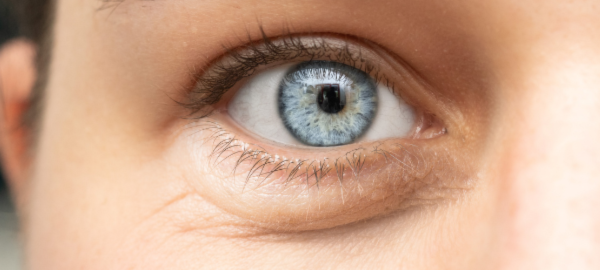
The iris is the coloured part of the eye, which is most commonly brown, blue or green. The iris is one of three parts of the middle layer of the eye, and contains the muscles that control the size of your pupil by making it contract and expand.
Pupil
The pupil is the black circle inside the iris and is another component of the middle eye. The muscles inside the iris control the size of the pupil to manage how much light enters the eye.
Lens
The lens is the third component of the middle layer of the eye. It focuses the light that enters your eye and directs it to the retina.
Retina
The retina is the innermost layer of light-sensitive cells located at the back of the eye. It converts light into signals that it then transmits these signals to the brain via the optic nerve.
Macula
The macula is instrumental to detailed central vision as it helps us see colour and fine details. As it’s in the centre of the retina, it’s responsible for processing most of what is directly in view.
Peripheral Retina
The peripheral retina is the outermost part of the retina which is responsible for your peripheral vision.
Optic nerve
This is the nerve that connects the retina at the back of the eye to the brain. It carries signals from the eyes to the visual cortex, the part of the brain responsible for sight.
External muscles
Alongside the internal muscles, there are external muscles around the eye that control its movement and position. These muscles also contribute to the eye’s shape.
DID YOU KNOW?
Your eyes are the second most complex organ in the human body, second to the brain.
The Brain-Eye Connection
Although eyes do have a certain aesthetic value, the eye primarily enables eyesight, an essential sensory function.
To do so, eyes capture and process light to create the images we see. Light first enters through the cornea, which helps focus it. The pupil, controlled by the muscles in the iris, regulates light intake by adjusting its size based on brightness levels.
Once inside the eyes, light passes through the lens, which changes shape to refine focus. The lens then directs it onto the retina, which contains rods which detect light and dark, and cones, which enable colour perception and sharp detail.
The image formed on the retina is inverted, but the optic nerve then transmits signals to the visual cortex, which corrects the image. The visual cortex also integrates the input from each eye into a coherent image, creating depth perception.
The above process happens almost instantaneously. As sight is the primary sense through which we experience the world, this elaborate system allows us to map and navigate our surroundings.
A variety of factors can affect your vision. The eye muscles are constantly making subtle changes to the eye’s shape, directing the focus point so that light lands correctly on the retina.
The focus needs to be exact, and when it isn’t, vision appears blurry; similar to how a picture comes out blurry when a camera lens is out of focus.
Additionally, if the optic nerve is impaired, or if the connection between the eye and brain is not well developed, the signals sent to the brain won’t be interpreted correctly, making it difficult to see.
The process of seeing is clearly a very intricate process, with several connective elements that require perfect execution to achieve perfect vision.
However, if you’re struggling with your vision, you’re certainly not alone. Read further as we explain some of the many eye conditions that can affect your vision.
Eye Conditions
As the eye is such a complex organ, there are various conditions and diseases that can disrupt its proper function. These conditions can be determined by several factors, including genetics, exposure, and a person’s overall health.
Our eyes are composed of various types of tissue, including muscles, nerves, connective tissue, and blood vessels. When any of these components become damaged, the eye is unable to properly send signals to the brain’s visual cortex.
Refractive Errors
Refractive errors are some of the most common issues when it comes to eyes. In fact, your vision may be affected by a light refractive error without you even noticing it.
Refractive errors included three types; nearsightedness, farsightedness, and vision distortions such as astigmatism.
Retinal disorders
Damage to the retina can occur because of genetic or environmental factors. Retinal disorders include holes in the retina, detachment of the retina, diabetes-related retinopathy, and age-related macular degeneration.
Corneal disorders
Corneal disorders can be congenital conditions you are born with, or conditions which develop later on in life. Some of the most common corneal disorders include allergies, keratitis, dry eyes, or corneal dystrophies.
Optic nerve conditions
Injury or impairment of the optic nerve can have a significant negative effect on one’s vision as this nerve connects the eye to the brain’s visual cortex.
Some optic nerve conditions you may be familiar with include glaucoma and optic nerve atrophy; both of which reduce the field of vision and can lead to vision loss.
Age-related eye disorders
The severity of age-related eye disorders can range from the loss of near vision, known as presbyopia, to more serious concerns like cataracts, glaucoma, and age-related macular degeneration.
Since some age-related eye diseases are severe enough to cause permanent vision loss when not treated properly, it’s important to stay on top of eye health and get regular check-ups.
Eyes are also susceptible to more general illness or injury, including infections like conjunctivitis, injuries and trauma from sport, or even eye cancer, though this is rare.
When should I go for a vision test?
You should visit your optical dispenser once every 2 years, or more often if you require specialised care. This is crucial to maintain your eye health and update your prescription as necessary.
It’s also important to protect your eyes to prevent damage. Blue light glasses can help filter out the harmful blue-light emitted by digital devices, making them a great option for those who spend a lot of time at the computer.
Eyes are also highly sensitive to UV rays, so it’s important to wear protective sunglasses with UV protection when exposed to the sun.
If you have any further questions about eye anatomy or health, you can visit our Optical Center for more resources on eye related topics. If you still have doubts, feel free to reach out to one of our certified opticians. They’ll be happy to help.
Related articles


Related articles